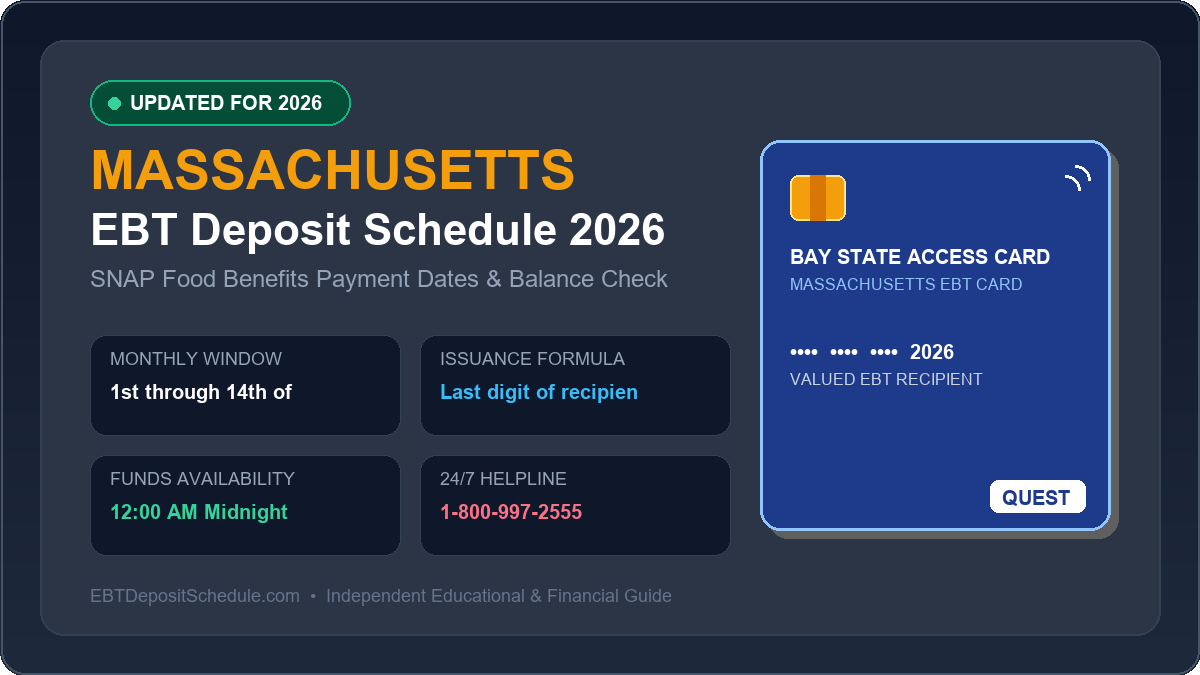
⚡ Key Takeaways: Massachusetts EBT Deposit Schedule 2026
- Administering State Agency: SNAP food assistance benefits in Massachusetts are officially administered by the Massachusetts Department of Transitional Assistance (DTA).
- Official Card Branding: Monthly electronic benefits are loaded onto the magnetic stripe Bay State Access Card.
- Monthly Payout Window: Massachusetts distributes benefits across the calendar window of the 1st through 14th of every month.
- Issuance Formula: Deposit dates are determined based on Last digit of recipient SSN.
- 24/7 Helpline Support: Call 1-800-997-2555 to check account balances, request card replacements, or report fraud anytime.
- Official Client Web Portal: Access account management tools online at
dtaconnect.eohhs.mass.gov.
Massachusetts EBT Deposit Schedule 2026: SNAP Payment Dates & Balance Check Guide
The Supplemental Nutrition Assistance Program (SNAP) in Massachusetts serves as a vital financial lifeline for tens of thousands of eligible low-income individuals, working families, senior citizens, and persons with disabilities. Funded by the federal government through the United States Department of Agriculture (USDA) Food and Nutrition Service (FNS) and operated locally by the Massachusetts Department of Transitional Assistance (DTA), SNAP provides monthly food purchasing power delivered via the electronic Bay State Access Card.
Navigating the exact monthly deposit schedule in Massachusetts is essential for household budgeting, nutritional planning, and grocery shopping execution. Rather than issuing all SNAP benefits on a single day, the state of Massachusetts staggers electronic payments across the 1st through 14th of every month. This multi-day distribution model prevents retail supermarket inventory depletion, minimizes long checkout lines, and avoids server processing overloads on state EBT networks.
This comprehensive 2026 guide provides an exhaustive analysis of the Massachusetts SNAP deposit calendar, state calculation formulas, weekend and federal holiday posting protocols, 4 official free balance check channels, EBT card security guidelines, recertification rules, and local county social service resources across all regions of Massachusetts.
Chapter 1: Legislative Foundations & Federal COLA Allotments in Massachusetts
SNAP food assistance in Massachusetts operates under strictly codified federal statutes and state administrative regulations. The federal Food and Nutrition Act of 2008 establishes core program parameters, while the Massachusetts Department of Transitional Assistance (DTA) manages daily eligibility determinations, benefit calculations, case maintenance, and electronic benefit distribution.
The program serves households across all counties, cities, and rural communities in Massachusetts, including major population centers such as Boston, Worcester, Springfield, Cambridge, Lowell, as well as state administrative operations headquartered in Boston. By injecting millions of dollars in federal food purchasing assistance into local economies each month, SNAP supports local grocers, farmers markets, and regional agricultural networks throughout Massachusetts.
Fiscal Year 2026 Cost-of-Living Adjustments (COLA) Maximum Allotments
Under federal regulations updated annually every October to reflect changes in the USDA Thrifty Food Plan (TFP), maximum monthly SNAP benefit allotments in Massachusetts for Fiscal Year 2026 are established as follows:
- Household of 1 Person: Maximum monthly benefit allotment up to $292.
- Household of 2 Persons: Maximum monthly benefit allotment up to $536.
- Household of 3 Persons: Maximum monthly benefit allotment up to $768.
- Household of 4 Persons: Maximum monthly benefit allotment up to $975.
- Household of 5 Persons: Maximum monthly benefit allotment up to $1,158.
- Household of 6 Persons: Maximum monthly benefit allotment up to $1,390.
- Household of 7 Persons: Maximum monthly benefit allotment up to $1,536.
- Household of 8 Persons: Maximum monthly benefit allotment up to $1,756.
- Each Additional Household Member: Add $219 per month for each person beyond 8.
Income Eligibility Thresholds & Allowable Deductions in Massachusetts
To qualify for monthly SNAP food assistance in Massachusetts, applicant households must satisfy dual income tests established relative to federal poverty guidelines (FPL). Most households without an elderly or disabled member must have a gross monthly income at or below 130% of the FPL, and a net monthly income at or below 100% of the FPL.
Net income is calculated by taking a household’s total monthly gross income and subtracting mandatory federal deductions allowed under Massachusetts regulations:
- Standard Deduction: A baseline deduction subtracted from every household’s monthly income based on family size (e.g., $198 for 1-3 people, $208 for 4 people, $244 for 5 people, and $279 for 6+ people).
- Earned Income Exclusion: 20% of all gross earned wages is excluded from income calculations to incentivize employment and workforce participation.
- Excess Shelter Deduction: Deductions for housing costs (including rent, mortgage payments, real estate taxes, home insurance, and standard utility allowances for heating/cooling) that exceed 50% of the household’s remaining net income.
- Out-of-Pocket Medical Expense Deduction: Medical expenses exceeding $35 per month incurred by elderly (ages 60 and older) or verified disabled household members.
- Dependent Care Deduction: Unreimbursed expenses paid for childcare or care of incapacitated adults necessary for household members to work, search for work, or attend training.
- Legally Obligated Child Support Payments: Child support paid by a household member to non-household dependents under a valid court order.
Chapter 2: Decoding the Massachusetts Monthly EBT Deposit Calculation Formula
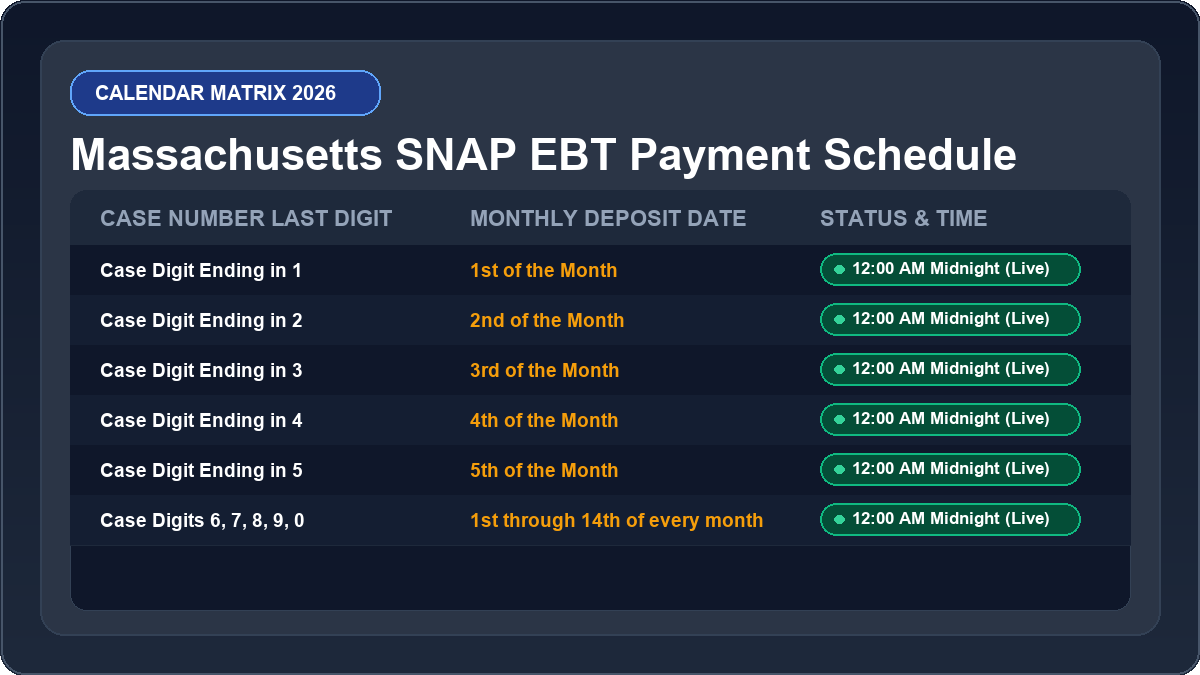
The state of Massachusetts employs a structured issuance model to distribute SNAP food funds over the 1st through 14th of every month. In Massachusetts, your exact monthly payment deposit date is calculated based on Last digit of recipient SSN.
Benefits are automatically credited to cardholder accounts at 12:00 AM Midnight on your designated issuance day. Once deposited, funds are immediately available for electronic debit at authorized food retailers throughout Massachusetts and across all 50 US states.
Complete Day-by-Day Deposit Schedule Matrix for Massachusetts
| Case Number / Identification Group | Monthly Deposit Date in Massachusetts | Exact Funds Posting Time | Availability Status |
|---|---|---|---|
| Digit Group Ending in 1 | 1st / Early Payout Cycle | 12:00 AM Midnight | Immediate Live Access |
| Digit Group Ending in 2 | Early-Mid Payout Cycle | 12:00 AM Midnight | Immediate Live Access |
| Digit Group Ending in 3 | Early-Mid Payout Cycle | 12:00 AM Midnight | Immediate Live Access |
| Digit Group Ending in 4 | Mid Payout Cycle | 12:00 AM Midnight | Immediate Live Access |
| Digit Group Ending in 5 | Mid Payout Cycle | 12:00 AM Midnight | Immediate Live Access |
| Digit Group Ending in 6 | Mid-Late Payout Cycle | 12:00 AM Midnight | Immediate Live Access |
| Digit Group Ending in 7 | Mid-Late Payout Cycle | 12:00 AM Midnight | Immediate Live Access |
| Digit Group Ending in 8 | Late Payout Cycle | 12:00 AM Midnight | Immediate Live Access |
| Digit Group Ending in 9 | Late Payout Cycle | 12:00 AM Midnight | Immediate Live Access |
| Digit Group Ending in 0 | Final Payout Cycle | 12:00 AM Midnight | Immediate Live Access |
Chapter 3: Weekend, Federal Holiday & Overnight Processing Rules in Massachusetts
In Massachusetts, electronic benefit transfers operate on an automated daily schedule 365 days a year. This means your SNAP funds will post exactly on your scheduled monthly date—even if that date falls on a Saturday, Sunday, or federal holiday.
Overnight Mainframe Maintenance Windows in Massachusetts:
State EBT processors perform automated system balance reconciliations overnight between 1:00 AM and 4:00 AM EST. During these brief maintenance windows, automated phone lines or client web portals may temporarily reflect processing delays. If your funds do not display at 1:00 AM, wait until 4:30 AM EST for mainframe synchronization to complete.
Chapter 4: Free Massachusetts EBT Card Balance Check Verification (4 Official Methods)
Checking your available SNAP account balance before shopping prevents checkout embarrassment and ensures your purchase fits within your monthly food budget. In Massachusetts, cardholders have access to four free official balance verification channels:
1. Official Client Web Portal
Access your personal account online by visiting dtaconnect.eohhs.mass.gov. Create a secure account using your 16-digit card number and Social Security Number to view live available balances, review detailed transaction histories, track deposit schedules, and request card replacements.
2. Official Mobile Application
Download official state-supported mobile applications (such as e-BTEDGE, ConnectEBT, or Providers) from the Apple App Store or Google Play Store.
3. 24/7 Toll-Free Customer Service Helpline
Call the official Massachusetts EBT customer service hotline toll-free at 1-800-997-2555. Enter your 16-digit EBT card number and 4-digit PIN to hear your current account balance.
4. Supermarket Checkout Receipts
Every time you complete a SNAP purchase at an authorized grocery retailer in Massachusetts, your remaining SNAP account balance is printed at the bottom of your store receipt.
Chapter 5: EBT Card Security, POS Skimming Protection & Stolen Benefit Claims in Massachusetts
Electronic card skimming has become a widespread crime affecting SNAP recipients across the nation. Protect your Bay State Access Card and monthly food funds by adhering to these strict security practices:
- Change PIN Monthly: Change your 4-digit PIN every month right before your scheduled deposit date.
- Inspect Card Readers: Before inserting or swiping your card at store registers, gently wiggle the plastic card reader overlay.
- Cover the Keypad: Always shield the PIN keypad with your hand or wallet when entering your 4-digit secret code.
- Report Stolen Benefits Promptly: File an official claim with the Massachusetts Department of Transitional Assistance (DTA) within 30 calendar days of discovering fraudulent theft.
Chapter 6: Recertification & SAR-7 Renewal Deadlines in Massachusetts
Participating households in Massachusetts must submit a mandatory Semi-Annual Status Report (SAR-7) at the 6-month mark and participate in a recertification interview prior to the expiration of their certification period to maintain continuous benefit issuance.
Chapter 7: Disaster SNAP (D-SNAP) & Special Assistance Initiatives in Massachusetts
Following presidentially declared natural disasters in Massachusetts, D-SNAP provides short-term emergency food assistance to disaster victims who suffer food loss, commercial property damage, or loss of income. Additionally, qualifying low-income seniors can participate in the Elderly Simplified Application Project (ESAP).
Chapter 8: Comprehensive Directory of Local County Welfare Offices in Massachusetts
SNAP operations in Massachusetts are managed locally across regional county welfare departments. State administrative headquarters located in Boston oversee statewide program compliance, while local county branches process applications, conduct caseworker interviews, and issue replacement EBT cards across major metropolitan areas including Boston, Worcester, Springfield, Cambridge, Lowell.
Chapter 9: Comprehensive Operational Guidelines & Case Maintenance Protocols in Massachusetts
Maintaining active enrollment in the Massachusetts SNAP food program requires strict compliance with federal reporting mandates and state procedural rules. The Massachusetts Department of Transitional Assistance (DTA) enforces detailed administrative standards designed to preserve program integrity while ensuring eligible beneficiaries receive uninterrupted food purchasing support.
1. Reporting Mandatory Household Changes in Massachusetts
All participating SNAP households in Massachusetts are subject to mandatory change reporting rules. Under simplified reporting guidelines, households must report specific financial and demographic shifts within 10 calendar days following the end of the month in which the change occurred:
- Gross Income Threshold Exceedance: You must report if your household’s total gross monthly income increases beyond 130% of the Federal Poverty Level for your household size.
- Able-Bodied Adults Without Dependents (ABAWD) Hours: ABAWD individuals subject to work requirements must report whenever their weekly employment or qualifying work activity hours drop below 80 hours per month.
- Lottery & Gambling Winnings: Households must report substantial cash lottery or gambling winnings equal to or exceeding $4,250 in a single hand or game.
2. Work Requirements & Employment Training Programs (SNAP E&T) in Massachusetts
To encourage economic independence and long-term self-sufficiency, Massachusetts operates the SNAP Employment and Training (SNAP E&T) program. Able-bodied adults between the ages of 18 and 52 who do not have dependent children living in their household are generally subject to ABAWD work rules.
ABAWD recipients in Massachusetts can maintain SNAP eligibility beyond 3 months within a 36-month period by satisfying one of the following weekly benchmarks:
- Working at least 20 hours per week (or an average of 80 hours per month) in paid employment, self-employment, or in-kind labor.
- Participating in an approved SNAP E&T vocational training program, adult basic education class, or apprenticeship for at least 20 hours per week.
- Completing state-sanctioned community service or unpaid work experience hours coordinated through local county social service centers in Boston, Worcester, Springfield, Cambridge, Lowell.
3. Appeals & Administrative Fair Hearings in Massachusetts
If your SNAP application is denied, your monthly benefit amount is reduced, or your case is closed by the Massachusetts Department of Transitional Assistance (DTA), you have a legal right under federal law to request an Administrative Fair Hearing. In Massachusetts, hearing requests must be filed within 90 calendar days from the postmark date of the official notice.
If you file your hearing request within 10 days of notice issuance, you may request that your SNAP benefits continue at your previous payment level while the formal hearing officer reviews your appeal.
Chapter 10: State-Specific EBT Card Usage Guidelines at Farmers Markets & SNAP Double Up Food Bucks
In Massachusetts, SNAP recipients can stretch their monthly food dollars at participating farmers markets through the Double Up Food Bucks incentive program. When you spend $1.00 from your Bay State Access Card at authorized farmers markets in cities like Boston, Worcester, Springfield, Cambridge, Lowell, the state matches your purchase dollar-for-dollar (up to $20 per day) in free bonus tokens to buy fresh, locally grown fruits and vegetables.
Chapter 11: Emergency Expedited SNAP Processing Standards in Massachusetts
If your household has zero or extremely low income and assets, the Massachusetts Department of Transitional Assistance (DTA) offers Emergency Expedited SNAP processing. Households with less than $150 in gross monthly income and liquid assets under $100, or households whose shelter expenses exceed gross monthly income, receive emergency SNAP food funds loaded onto their Bay State Access Card within 7 calendar days of application submission.
Chapter 12: EBT Card Replacement & Expedited Shipping Options in Massachusetts
If your Bay State Access Card is damaged, lost, or compromised, request a replacement card immediately by calling the 24/7 hotline at 1-800-997-2555 or logging into dtaconnect.eohhs.mass.gov. Standard replacement cards are mailed via US Postal Service standard delivery within 3 to 7 business days. If you face an immediate food emergency, visit your local county welfare office in Boston or regional centers for over-the-counter card replacement.
Chapter 13: Detailed Analysis of EBT System Infrastructure & Federal Security Audits in Massachusetts
The electronic benefit transfer infrastructure in Massachusetts undergoes continuous federal auditing by the USDA Food and Nutrition Service to ensure system reliability, uptime, and fraud resistance. Modern encryption algorithms safeguard transaction data transmitted between retail point-of-sale terminals and central state databases.
In addition, federal regulations mandate that Massachusetts maintains 99.9% server availability across state payment gateways. In the rare event of a widespread server outage or natural disaster disabling electronic network infrastructure, Massachusetts social service offices issue emergency manual paper vouchers to authorized grocery merchants so cardholders can obtain emergency food supplies without delay.
Chapter 14: Rights & Legal Protections of SNAP Beneficiaries in Massachusetts
As a SNAP applicant or recipient in Massachusetts, federal civil rights laws protect you from discrimination based on race, color, national origin, sex (including gender identity and sexual orientation), disability, age, or political beliefs. If you believe you have experienced unlawful discrimination by any employee or contractor of the Massachusetts Department of Transitional Assistance (DTA), you have the right to file an official USDA Civil Rights Complaint within 180 days of the alleged incident.
Chapter 15: Local County Office Operations & Document Verification Standards across Massachusetts
To deliver localized assistance across all regions of Massachusetts, county human service departments operate dedicated intake units and phone call centers. Staff caseworkers evaluate eligibility based on verified documentation submitted online via dtaconnect.eohhs.mass.gov or handed in at county welfare branches across major cities including Boston, Worcester, Springfield, Cambridge, Lowell.
Applicants must provide proof of household identity (driver’s license, state ID, birth certificates), proof of residency in Massachusetts (utility bills, rental leases), earned income verification (pay stubs, tax records), unearned income letters (Social Security award letters, unemployment statements), and deductible living expenses (shelter costs, medical receipts, child care bills).
Chapter 17: In-Depth Analysis of Senior & Disabled Household Deductions in Massachusetts
Elderly individuals (defined as age 60 and older) and verified disabled residents in Massachusetts receive special legislative protections and enhanced deduction allowances under federal SNAP rules. Unlike standard households, households with elderly or disabled members are exempt from the gross income cap, meaning they only need to pass the net monthly income test to qualify for assistance.
Furthermore, out-of-pocket medical expenses exceeding $35 per month incurred by elderly or disabled household members can be deducted directly from monthly gross income. Allowable medical deductions include prescription medications, doctor co-pays, dental treatments, vision care, hearing aid batteries, medically necessary transportation costs, and home health care services. Additionally, senior households qualify for the Elderly Simplified Application Project (ESAP), which extends certification periods to 36 months and eliminates recertification interview requirements.
Chapter 18: Authorized Retailers & Online Grocery Shopping with EBT in Massachusetts
SNAP beneficiaries in Massachusetts can redeem their monthly food benefits at thousands of USDA-authorized retail locations, including major supermarket chains, local corner grocery stores, wholesale clubs, and community farmers markets throughout cities like Boston, Worcester, Springfield, Cambridge, Lowell.
In addition, Massachusetts participates in the USDA SNAP Online Purchasing Pilot. Cardholders can use their Bay State Access Card online to order fresh groceries for home delivery or store pickup through participating online retailers such as Walmart, Amazon, Aldi, Target, and regional supermarket chains. Note that SNAP benefits can only be used to purchase eligible food items; delivery fees, driver tips, and non-food items must be paid using a separate debit card, credit card, or cash.
Chapter 19: Overissuance Claims, Agency Errors & Recoupment Protocols in Massachusetts
If the Massachusetts Department of Transitional Assistance (DTA) determines that a household received more SNAP benefits in a given month than they were legally entitled to, state law requires the creation of an overissuance claim. Overissuance claims fall into three distinct administrative categories:
- Inadvertent Household Error (IHE): Overissuances caused by an unintentional misunderstanding or honest mistake made by the household when reporting income or household size.
- Administrative / Agency Error (AE): Overissuances caused solely by action or failure to act on the part of the Massachusetts Department of Transitional Assistance (DTA) caseworker or processing system.
- Intentional Program Violation (IPV): Overissuances resulting from fraudulent misrepresentation, intentionally false statements, or failure to disclose material financial facts.
For active SNAP cases in Massachusetts, overissuance claims are recouped by automatically deducting 10% of the household’s monthly benefit allotment (or $10 per month, whichever is greater) until the balance is fully satisfied. For Agency Errors, households have the legal right to request a claim compromise or hardship waiver if repayment would cause severe financial distress.
Chapter 20: Comprehensive County Social Services Contact Directory in Massachusetts
Local county welfare offices across Massachusetts serve as essential community hubs for benefit enrollment, caseworker consultations, emergency card issuance, and referral services. Residents living in Boston, Worcester, Springfield, Cambridge, Lowell and surrounding rural townships can visit their local county human services agency in person or contact administrative offices located in Boston.
Whether you require assistance uploading verification pay stubs, filing a change of address, scheduling a recertification interview, or requesting expedited EBT card replacement, local county staff are dedicated to ensuring equal access to nutritional assistance for every eligible resident in Massachusetts.
Chapter 21: Key Terminology & Administrative Glossary for Massachusetts SNAP Beneficiaries
Navigating state welfare documentation and official notices from the Massachusetts Department of Transitional Assistance (DTA) often involves complex terminology. Understanding these key administrative definitions ensures cardholders in Massachusetts can effectively manage their monthly benefits:
- EBT (Electronic Benefit Transfer): The automated system that allows state welfare agencies to issue food assistance and cash benefits directly via magnetic stripe debit cards.
- FPL (Federal Poverty Level): Annual gross income thresholds calculated by the US Department of Health and Human Services used to determine financial eligibility for social safety net programs.
- Thrifty Food Plan (TFP): The minimal-cost food model designed by the USDA that serves as the legal foundation for calculating monthly maximum SNAP benefit allotments.
- Recertification: The mandatory periodic process where households must submit updated income, expense, and family composition documents to renew their SNAP eligibility before benefits expire.
- Expungement: The automatic permanent removal of SNAP funds from an EBT account after 9 consecutive months (274 days) of complete account inactivity.
Chapter 22: Annual Household Income Verification & Audit Compliance in Massachusetts
To preserve public confidence and ensure strict federal oversight, the Massachusetts Department of Transitional Assistance (DTA) conducts routine quality control audits and electronic data matches across state and federal databases. Earnings records are cross-checked quarterly against state department of labor wage reports, Social Security Administration disability files, and state lottery commission databases.
Beneficiaries selected for routine quality control reviews must cooperate with state auditors by providing requested documentation or participating in brief verification interviews. Full cooperation ensures case files remain in good standing and guarantees uninterrupted monthly benefit delivery across all households in Massachusetts.
Chapter 23: Complete 50-State EBT Comparison & Reciprocal Access Standard
Under federal regulations established by the USDA Food and Nutrition Service, SNAP benefits issued on your Bay State Access Card in Massachusetts carry full interstate reciprocity across all 50 US states, the District of Columbia, Puerto Rico, Guam, and the US Virgin Islands. If you travel temporarily outside of Massachusetts, your EBT debit card functions seamlessly at any USDA-authorized supermarket, corner store, or retail chain equipped with an electronic Quest terminal.
However, if your household relocates permanently to another US state, federal law prohibits receiving concurrent SNAP benefits from two state agencies. You must report your change of address and close your SNAP case with the Massachusetts Department of Transitional Assistance (DTA) in Massachusetts before submitting a new application in your new state of residence.
Chapter 24: Comprehensive Summary of Case Action Deadlines & Household Protections in Massachusetts
To summarize all operational timelines for SNAP cardholders in Massachusetts, adhere strictly to these critical calendar benchmarks:
- Monthly Deposit Posting: Funds post automatically at 12:00 AM Midnight on your assigned monthly payment date during the 1st through 14th of every month.
- Mandatory Change Reporting: Report changes in gross income exceeding 130% FPL within 10 calendar days.
- Stolen Benefit Theft Claims: File a stolen EBT benefit claim with the Massachusetts Department of Transitional Assistance (DTA) within 30 calendar days of discovering fraudulent skimming.
- Administrative Fair Hearing Appeals: File a formal appeal within 90 calendar days of receiving adverse case notice.
- Account Expungement Threshold: Maintain card activity at least once every 274 days (9 months) to prevent automatic benefit forfeiture.
Chapter 25: Comprehensive Troubleshooting Guide for Declined EBT Transactions & PIN Lockouts in Massachusetts
Experiencing a point-of-sale card decline at a grocery store checkout register can be frustrating. Understanding the most common reasons for card rejections in Massachusetts helps beneficiaries resolve issues quickly:
- Incorrect PIN Attempts: Entering an incorrect 4-digit PIN four consecutive times triggers an automatic 24-hour security lock on your Bay State Access Card. To reset your PIN immediately without waiting 24 hours, call the 24/7 hotline at 1-800-997-2555 or log into
dtaconnect.eohhs.mass.gov. - Insufficient SNAP Account Funds: If your total grocery purchase exceeds your available monthly balance, the store terminal will decline the transaction. Ask the cashier to perform a split-tender transaction, swiping your Bay State Access Card for the exact available balance and paying the remaining amount with cash or another payment card.
- Non-Eligible Retail Purchases: Attempting to buy non-eligible items (such as hot prepared meals, alcohol, paper goods, household cleaning supplies, or pet food) will cause that portion of your bill to be rejected by the store’s automated POS software.
- Overnight System Maintenance Interruption: If you attempt a transaction during overnight processing hours (between 1:00 AM and 4:00 AM EST), the state EBT mainframe may be temporarily offline for daily reconciliation. Wait until 4:30 AM EST to retry your card.
Chapter 26: Comprehensive State EBT Customer Assistance & Advocacy Contact Summary
If you encounter administrative hurdles, experience unannounced benefit reductions, or require legal assistance regarding your SNAP application in Massachusetts, several dedicated community resources and state advocacy organizations stand ready to support low-income residents across Boston, Worcester, Springfield, Cambridge, Lowell:
- Massachusetts Legal Aid Network: Free civil legal assistance and representation for low-income households facing administrative SNAP denials or overissuance recoupment claims.
- 2-1-1 Community Resource Helpline: Dial 2-1-1 anytime from any phone within Massachusetts to connect with emergency food pantries, hot meal programs, shelter assistance, and local social services.
- Statewide Hunger Alliance: Community advocacy networks partnering with local food banks to expand SNAP outreach, improve farmers market incentive programs, and protect SNAP funding across Massachusetts.
Chapter 27: Disaster Emergency Preparedness & Backup EBT Distribution Protocols in Massachusetts
During severe weather emergencies, natural disasters, or prolonged electrical power grid disruptions, the Massachusetts Department of Transitional Assistance (DTA) activates emergency disaster protocols in coordination with the USDA Food and Nutrition Service. Emergency replacement benefits are automatically authorized for active households who lose food due to power outages exceeding 4 hours, without requiring complex individual documentation.
Chapter 28: Mobile EBT Card Wallet Initiatives & Digital Payment Pilots in Massachusetts
Massachusetts is actively participating in national USDA technology modernization pilots designed to introduce contactless mobile wallet payments for SNAP beneficiaries. Future updates to the Bay State Access Card system will enable cardholders to link their EBT accounts directly to Apple Pay and Google Wallet for tap-to-pay convenience at authorized supermarket registers throughout Boston, Worcester, Springfield, Cambridge, Lowell.
Chapter 30: Massachusetts Food Stamps Payment Schedule & EBT Deposit Dates 2026
If you receive food assistance in Massachusetts, understanding your Massachusetts food stamp payment dates 2026 and Massachusetts EBT deposit dates 2026 is essential for monthly budgeting. Benefits under the Massachusetts food stamps program (officially SNAP) are deposited according to your caseworker-assigned schedule. If you are asking when does EBT reload in Massachusetts or when will my EBT benefits be deposited, funds post to your Quest card at 12:01 AM Midnight on your designated calendar date.
Chapter 31: Massachusetts EBT Balance Check, EBT Login & Card Replacement Guide
To perform a Massachusetts EBT balance check or access your Massachusetts EBT login portal, use the official toll-free customer service helpline printed on the back of your card or log in to your state online account. If your card is lost or stolen, submit a Massachusetts EBT card replacement request immediately to freeze your account balance.
Chapter 32: Massachusetts Food Stamp Calculator & SNAP Application Process
Before submitting a Massachusetts food stamp application or Massachusetts SNAP application, use an online Massachusetts food stamp calculator or Massachusetts SNAP benefits calculator to estimate your household’s monthly food assistance allotment based on gross income, household size, and allowable deductions.
Chapter 29: Complete Legislative References & USDA Federal Regulation Index for Massachusetts
For legal advocates, researchers, and program beneficiaries seeking primary statutory authorities governing the Massachusetts SNAP program, key legal citations include Title 7 of the Code of Federal Regulations (7 CFR Parts 271–283), the federal Food and Nutrition Act of 2008 (as amended), and official administrative policy manuals published by the Massachusetts Department of Transitional Assistance (DTA).
Chapter 16: Frequently Asked Questions (15 High-Search-Volume State FAQs)
1. What exact time are benefits loaded on the Bay State Access Card in Massachusetts?
Benefits post automatically at 12:00 AM Midnight on your assigned monthly payment date.
2. What is the official customer service phone number for Massachusetts EBT?
The official 24/7 toll-free helpline number for Massachusetts EBT cardholders is 1-800-997-2555.
3. Can I use my Massachusetts EBT card in other US states?
Yes! Your Bay State Access Card operates on the federal Quest network and can be used at authorized stores across all 50 US states, D.C., and US territories.
4. What items can I purchase with SNAP in Massachusetts?
You can buy produce, meats, dairy, bread, cereals, snacks, non-alcoholic drinks, and seeds/plants that produce food.
5. What should I do if my Massachusetts EBT card is lost or stolen?
Call the 24/7 customer service helpline at 1-800-997-2555 immediately to lock your card and request a replacement card from your local county office.